Showing posts with label hex tech tuesday. Show all posts

Tuesday, 1 November 2022

Hex Tower - New Technique - by Kim

 Do you remember the Lighthouse and the Spooky Windmill that I posted a while ago? Well I've been
thinking about the technique, and how to build the hexagon tower more easily. So I've come up with this method. Don't be put off by your first read through - it is easier than it looks.

I used the smallest hexagon, 24mm sides, and the largest hexagon, 50mm sides.

A ruler, sharp craft knife, and fast drying glue (PVA will do, but you may have to wait longer for it to set)
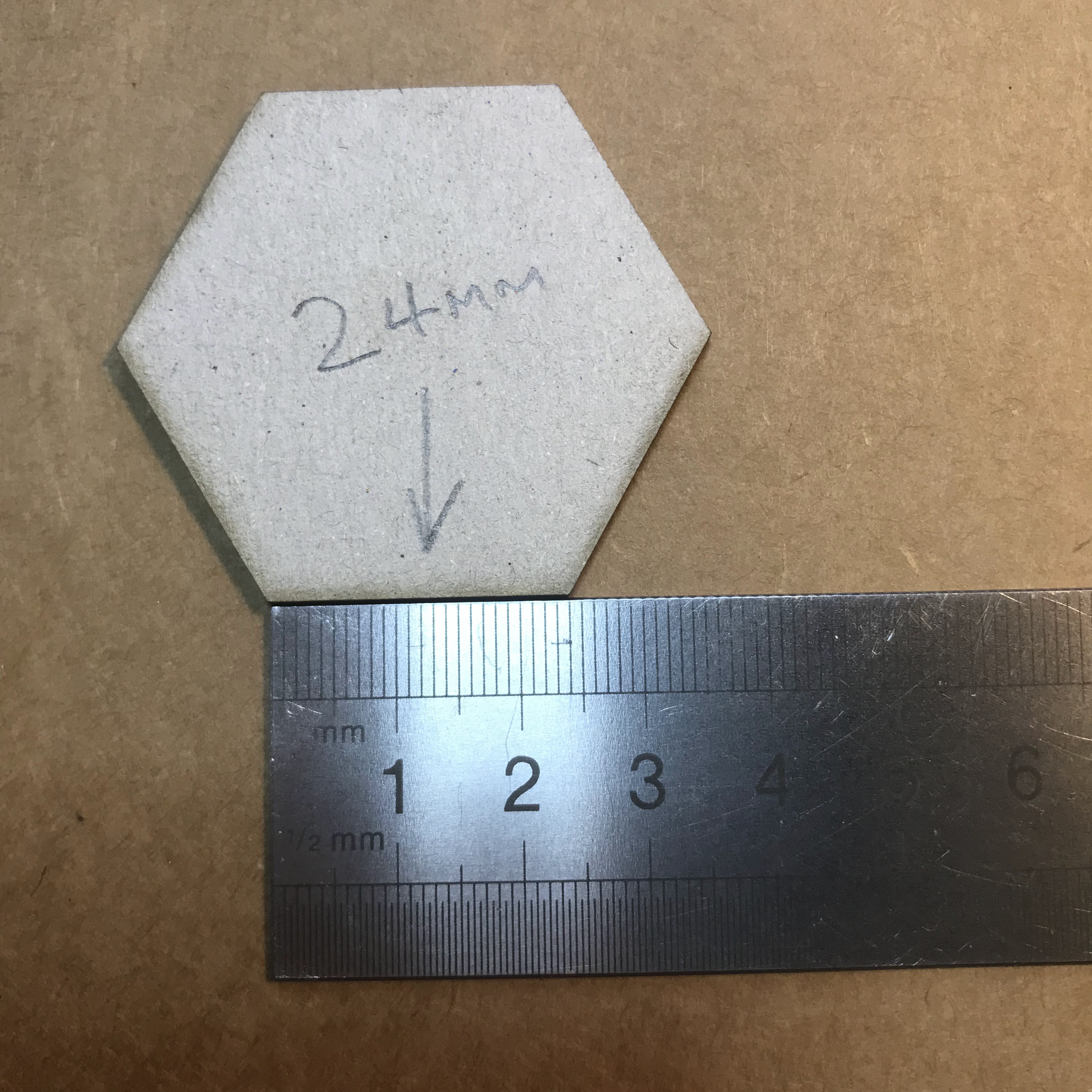


CUTTING

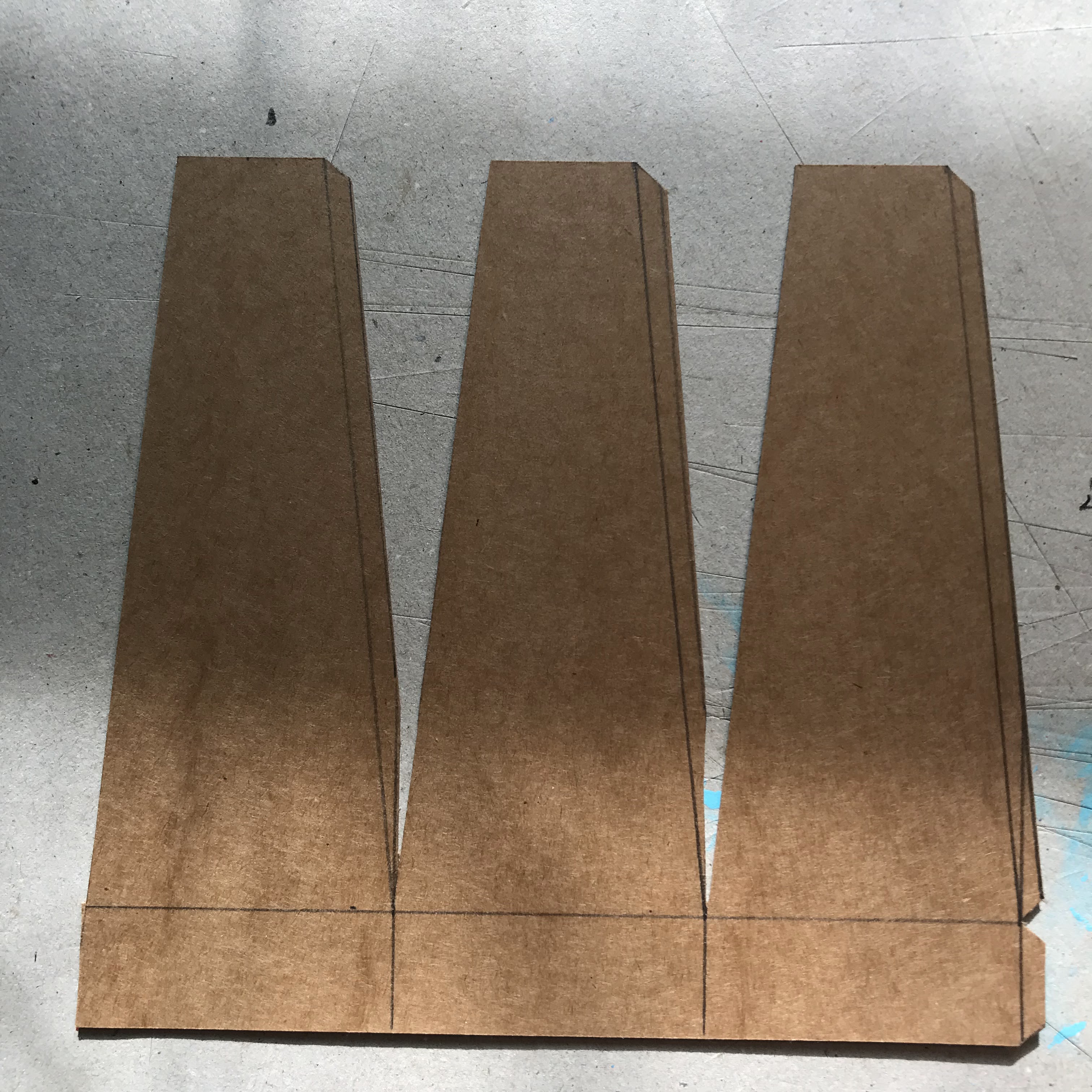
1    From a cereal box cut out the two big sides. Nice straight edges, please!
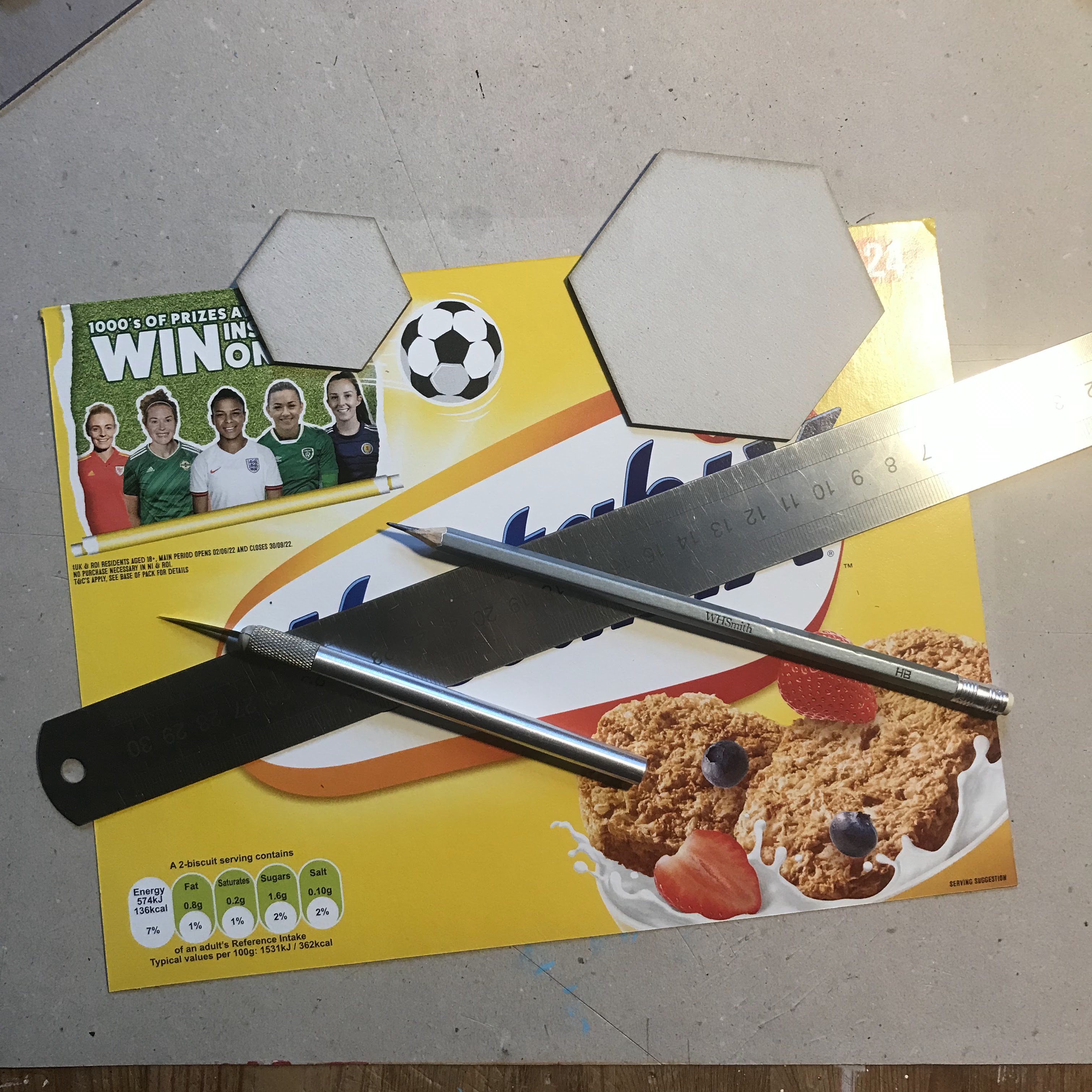
2    From the long edge measure 2cm and 14cm and draw lines across

3    From the left edge draw vertical lines at 5cm, 10cm, and 15cm

4    From the left edge mark the top centre of each of the panels created above - 2.5cm, 7.5cm, 12.5cm

5    Either side of the centre marks, mark 1.2cm. 

6    In each panel draw a line from the end of the 2cm line created at #2 to the corresponding point created at #5. 

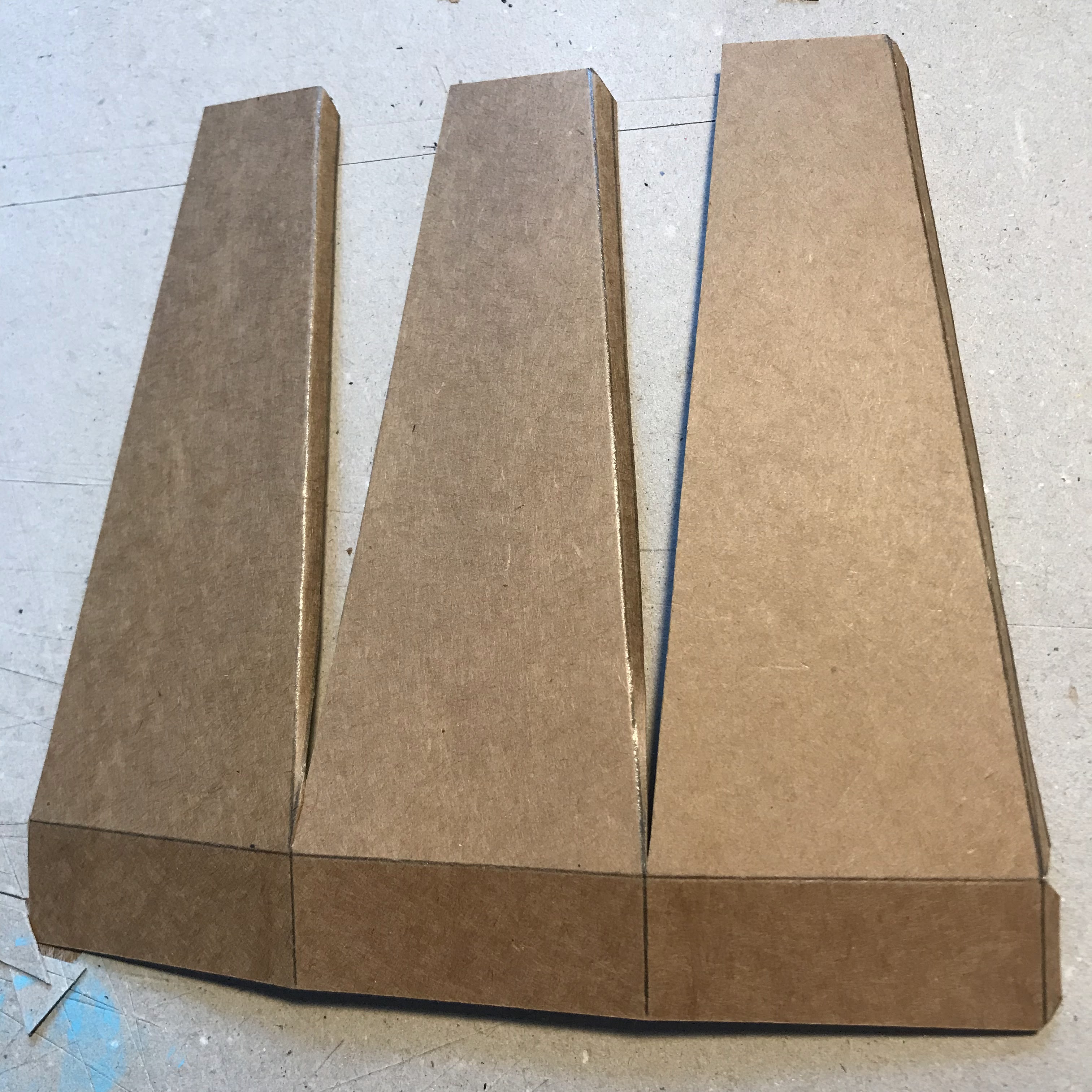
7    To the right of each tapered shape draw tabs for glueing - see photo for size and position.

8    Use the craft knife and ruler to cut out the shapes - make sure you include the glue tabs - see photos for required shape.


9    Repeat all the above for a second set of three sides.

10    Use an embossing tool/dotter with a ruler to put creases along the remaining pencil lines to help you fold the pieces into shape.


CONSTRUCTION

Check photos for positions

11    Start with the large hexagon (50mm) and one of the prepared side pieces. Apply glue just below the horizontal crease at the 2cm line, across all three panels. Place the edge of the large hex in centre panel and bring up the sides to match. Let it dry.

12    Apply glue to the tabs on the long sides. You may wish to do one at a time. Bring the tabs inside the adjacent edge and and adjust to make a tidy join. When both are done, let it dry.

13    Take the small hexagon (24mm). Apply glue around the inside of the top of the tower and place the small hex in to fit nicely level with the top of the panels. Let it dry.


14    Take the second side piece, apply glue to the tabs on the two inner long side (one at a time if you prefer) and form the tapered shape. You will not be able to get to these tabs once it is joined to the other half. Let it dry.


15    On your first half, apply glue to two edges of both the small and the large hex, and just along the inside of the long edge without tabs. Place the second 
half in position on top of the first, tucking the tabs inside to make contact with the glue. This is a but fiddly. Hold in place until dry.


16    Apply glue to the remaining edges of the hexs and the last tabs. Put the last panel in place, make any small adjustments before the glue sets. Let it dry.


17    To add strength to the bottom of the tower I used the largest hex ring - same size as the plain hex. I cut a small piece from the ring to allow it to fit and to be adjusted. I found it easier to slide the ring into the space at the bottom of the tower, making sure it fitted snugly, push it in too far, then apply glue around the inner edge and slide the ring out to meet it. Let it dry.


18    Make a brew and sit back and admire your handy work.

Once you have your raw tower it can be decorated however you wish. The Lighthouse was painted with DecoArt acrylics, the Spooky Windmill had Texture Sand and Modelling paste applied. You can cut holes for windows, install battery powered lights for special effects - you are limited only by your imagination. 

I have an idea for another hex project ...

Thank you for reading down this far. I hope you get to make a tower - remember you can adjust the measurements to suit your creation - and send photos so we can see how you get on!

Watch the YouTube video, too!


Tuesday, 28 June 2022

Hex Tex Tuesday- Abstract Wall Art- Fiona Randall


Welcome back for another Hex Tex Tuesday.

I love abstract art so decided to create a simple wall panel using the hexagons in a Monochromatic style.


I cut a Panel measuring 8x8ins from a Tando Grey Board Sheet and gave it a coat of DecoArt Chalky Finish in Carbon to both sides of the panel. Once dry I gave both sides of the panel a coat of DecoArt Ultra Matte varnish to seal and protect the chalky finish.
For this project I used 7 of the  hexagons . 

I gave all the hexagons a coat of DecoArt Media Tinting  base and dried with a heat tool.
Once dry I stamped all the hexagons with textures from Chocolate Baroque's Harlequin Fragments Rubber Stamp Set with Black Archival Ink.
I cut one of the hexagons as shown in the diagram below.


I drew a line from corner to corner left to right and then right to left.
As you will see you end up with a cross and have two diamond and two triangle shapes.
Cut along the cross lines with a ruler and a craft knife.

Next up arrange your hexagons onto the panel as shown.
To finish add a sentiment strip if desired.
I chose to go with a Monochromatic theme but this would look just as good using a riot of colour. The possibilities are endless.
A quick and easy project that would look great on any wall in your home or studio.
Thanks for taking the time to stop by and read
Fiona.

PRODUCTS USED.


Tuesday, 21 June 2022

Hex Tech Tuesday - Freedom by Kim

 I'm trying something a bit abstract this time. I hope you like it.

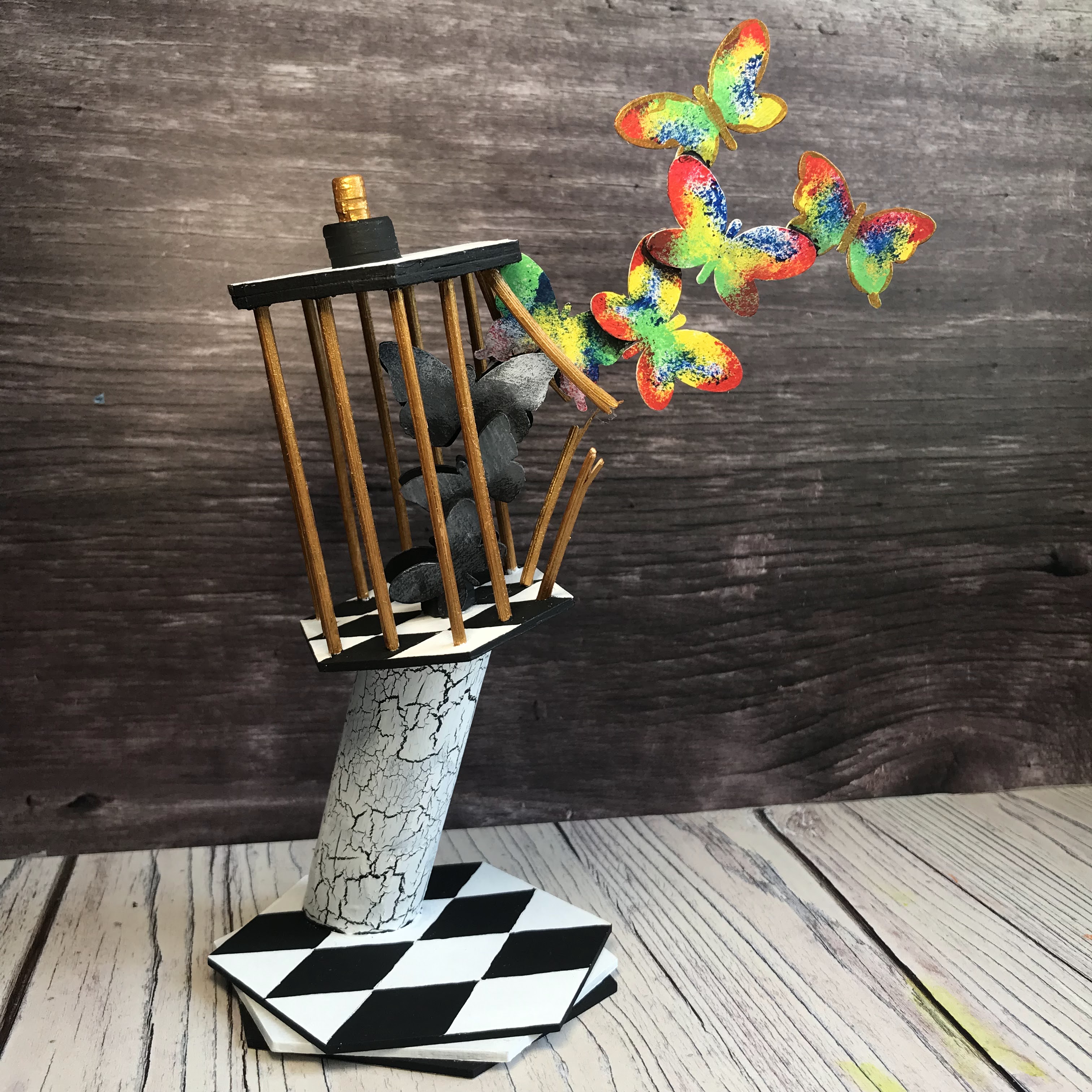
"Freedom!"


From the Tando Creative Hexagon set I used 3 x 3.5mm hexs, and 3 x 5mm hexs (that's length of the sides)

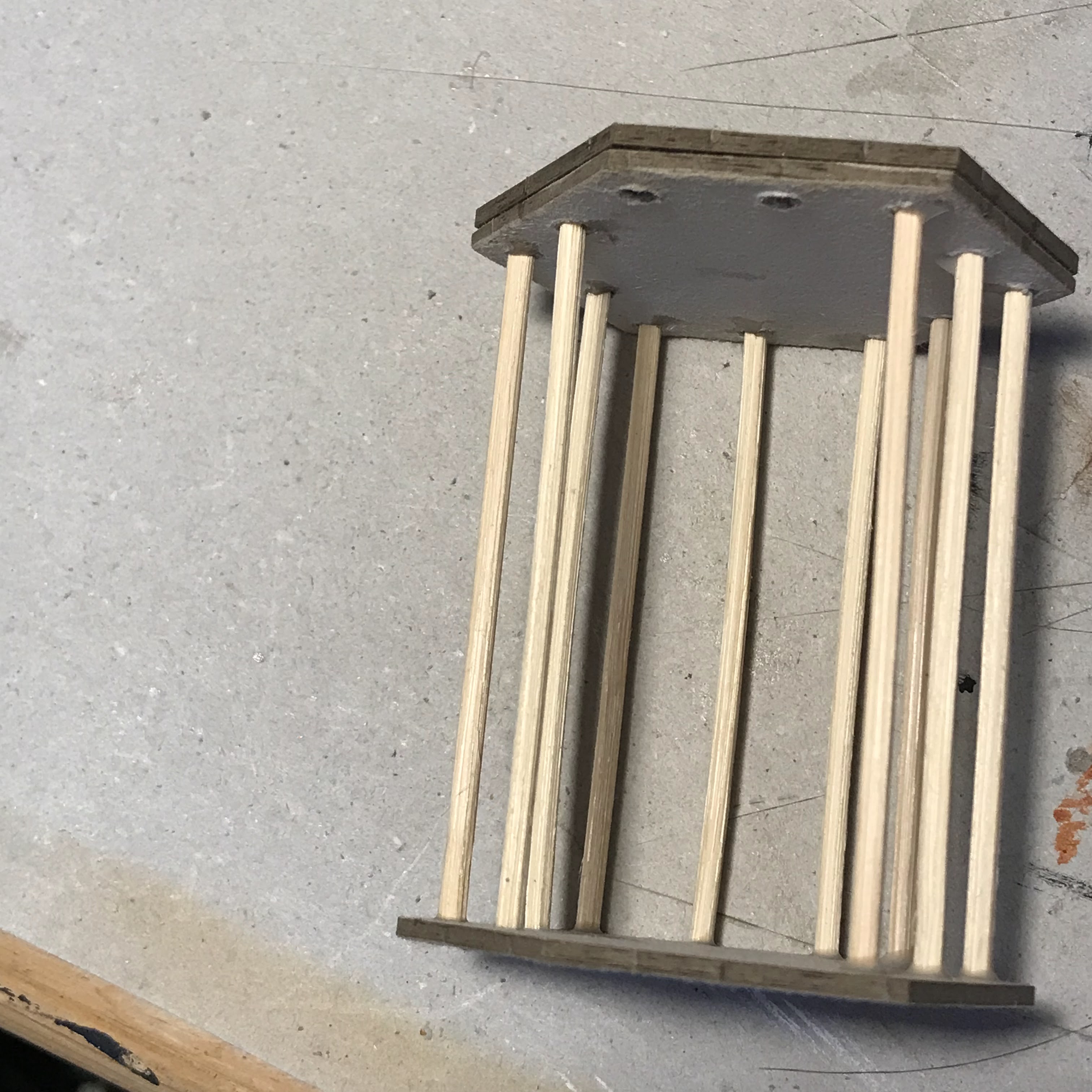
I started with the cage. For the bars I used clean bamboo sticks from a room infuser (the thing that has smelly oil in the bottom and sticks poking out to make the room smell nice). I drilled holes (as shown) in two of the 3.5mm hexs to take the bamboo sticks. The sticks were a bit too long so I cut them to 8cm. Before I glued them in I bent and broke two of them to allow the butterflies to escape.

Next stage was to glue the remaining ten sticks in place. I put them all in one hex then lined up the second hex to complete the cage. I glued the third 3.5mm hex on the top to cover the drill holes. I added some washers and rivets left over from Tando's Industrial Elements kit to decorate the top of the cage.

The stand is made from a piece of cardboard tube cut from a cooking foil roll. I wanted the whole thing to be skew-if, so I cut the bottom at an angle, and the top at an angle but not matching the bottom angle (see picture). I stuck the cut piece on a large hex. All was set aside to dry while I arranged the butterflies.

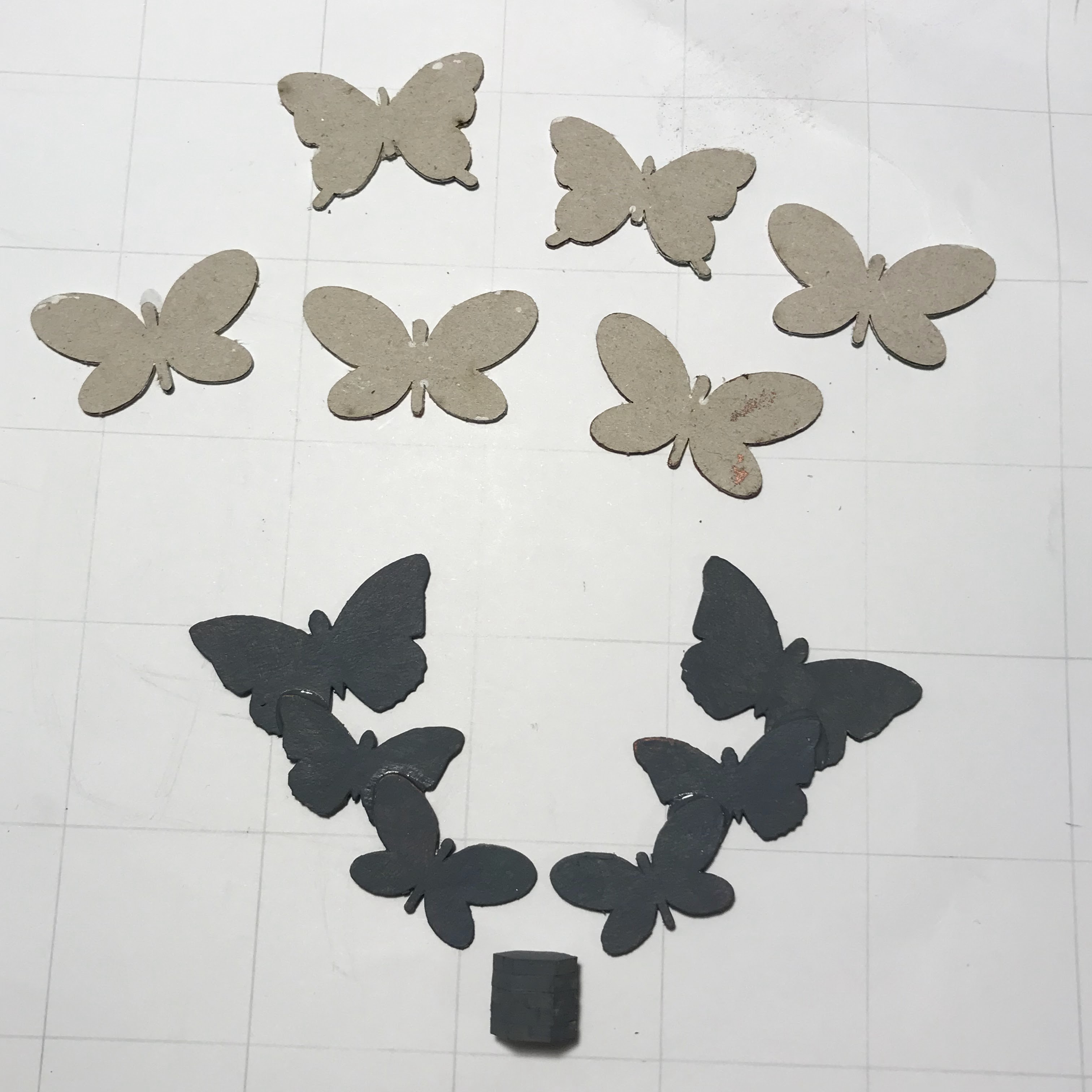
I took 11 butterflies from a set of Tando Mini Butterflies. I used six, three matching pairs, attached to a pile of four washers from Industrial Elements, to make a firm base section. The remaining butterflies were arranged as if flying out of the cage, their wing tips were glued together with PVA.


Before I assembled the sections I painted them. I used black and white for everything except the cage bars and escaping butterflies.

The cage floor was painted with a harlequin diamond shape, as was the top hex base. I feel there is something sinister about the design. The two remaining large hexs are painted one black, and one white.


The tube support for the cage was painted Lamp Black. When dry a coat of DecoArt Weathered Wood was applied and allowed to dry. White was painted over that to give the lovely crackle finish.

The cage bars are painted with Venetian Gold. The escaping butterflies are stippled with bright colours - I used yellow, green, red and blue, with the top two having gold edges to their wings. The three pairs of butterflies not escaping from the cage are painted black, with Zinc (grey) and white lightly dry brushed on to add texture.

Assembly (not the sort we had at the start of our school day!)

Glue the two large hexs under the base section. Make each one twisted slightly out of alignment, black on the bottom, white next.

Glue the dark and coloured butterfly sections together at the wings, making sure they fit nicely in the cage. When they are dry glue them in the opening of the cage. I added a bit of support by glueing the wing to the top of the cage. Allow to dry.

The broken cage bars can now be added, arranged to look like they have burst open. It is a bit fiddly and you will need to support each bit until the glue has set - might be worth using a solvent, quick drying glue here.


Last is to glue the cage to the stand, sit back and admire your handiwork!

I hope you enjoyed this Hex Tech. Thanks for stopping by!

Product:

Tando Creative Hexagons

Tando Creative Mini Butterflies

Bamboo sticks, or similar

DecoArt Americana Colours

DecoArt Weathered Wood

Tuesday, 7 June 2022

Hex Tech Tuesday - Time warp hexs by Kim

 It's Hex Tech Tuesday! This time I have a simple design for anyone to try.


I used Hexagon frames from Tando's Hexagons set, and a large box and drawer set. The set fits together really easily, so no problems there.


Once the glue was dry I started with a base coat of DecoArt Lamp Black all over the box and drawer, inside and out. While that was drying I chose my hexagon frames: 2 with 5cm sides, 1 with 4cm sides, 1 with 3cm sides.

To get the 3D effect I started with the 2 x 5cm hexs and glued them on top of each other with the sides offset (as in the picture). On top of that was glued the 4cm hex. This was in the same aspect as the first hex, but the tips of the points only just overlapped the one below, so you'll have to make sure it is lined up just right. The 3cm hex was oriented the same direction as the second, but the tips of the points only just reach the edge of the inside of the 4cm hex. So with this one I eased it inside the 4cm hex.

Once all the fiddly bits were dry I painted the whole group with DecoArt Titanium White. I wanted bright and gaudy colours for the dots on the white hexs, and found Daler Rowney System 3 fluorescent colours in Pink, Yellow, Orange, Green, and Blue. You may decide to use a different, tasteful combination. The dots were applied with an embossing tool with different sized ends. The group of hexs was set aside to dry.

On the front of the drawer, where the hexs are to be attached, I found the centre, and marked where the corners of the inner hex will be. Then from the corners towards the centre I added reducing dots. When all six corners have been done this gives the impression of a vanishing centre - through a time warp!

The edge of the drawer front was painted white. More reducing white dots were added to the box for decoration and to continue the effect of movement.

The group of hexs was then glued in position on the front of the box, making sure the corners of the inner hex matched the dotty pattern.

Thanks for dropping by. What are you creating with your hexagons? 

Products:

Tando Creatives Large boxes and drawers

Hexagon frames from the Hexagon set

DecoArt Americana Colours


Tuesday, 31 May 2022

Hex Tech Tuesday - 60s Retro Pop Art by Kim

  My idea for this design came from the angular shapes of the hexagons and the abstract art of the 1960s - particularly Piet Mondrian pop art.

I arranged the hexs and hex frames on the front cover in an attractive manner, and when happy with the placement I glued them on. I painted the background, outside the hexs, with DecoArt Americana True Red. 


When it was dry I applied DecoArt Media Crackle Paste thickly to the area painted red. My pot of crackle paste is quite old and I wasn’t sure if it would ‘crackle’ but it did, rather well. I left it overnight to ensure the  crackle process was complete and the paste had dried, and showed the red background through the cracks.


The background inside the hex frames I painted with DecoArt Americana Lamp Black. It was at this stage I had the idea of the chopstick ‘piercing’ the cover. I cut the chopstick at an angle to match the hexagon then shaved the cut ends so that they give the impression of disappearing through the cover. It is not glued in place yet.


To add to the 3D effect I cut a large hex into pieces but retained the angles of the hexagon and glued them on to the original set.


As the theme is 60s retro I went for a simple block design with bold colours - Titanium White, True Red, Lamp Black, with a touch of Bright Yellow to set it off. See the pictures for placement of colours. (Tip: Bright Yellow works better with either a white or Primary Yellow base coat as it is quite transparent)


I glued on the chopstick and, to enhance the 3D effect, I added shading with Lamp Black where it ‘enters and exits’ the cover.


The back cover is simply base coated with Titanium White and stamped with a model motif (by  Daniel Torrente) and sentiment suitable for the theme (by Limited Edition). I used black archival ink directly on the painted surface.


The covers and spine were joined with a hessian strip glued outside on the back cover and spine, and inside the front cover so as not to interfere with the design.


I haven't made book signatures to go inside this cover, but these would be made and sewn to the spine before adding the hessian, which would cover and hide the stitching.


Thanks for visiting … far out, man!


Products:

Tando Creative Book Binding cover (A5) (new)

Tando Creative Hexagons

DecoArt Crackle Paste

DecoArt Americana Colours

Hessian 

Found chopstick